

Children at New Creation Preschool are helped to not hurt themselves, others or things while we act from the belief that all behavior is either an act of love or a call for love. We use all conflict as an opportunity to connect further rather than isolate or separate. This means we don’t use nor do we threaten Time Out or exclusion from experiences and activities. Our classroom management and discipline style is a fundamental pillar of our program. Kristin has presented “The Rainbow Way” to other early childhood educators which summarizes seven important elements of the classroom management style at New Creation Preschool.

ROAM: By roaming the room, teachers are approachable. Children can more easily access teacher support and gain trust that their needs will be met. While roaming the room, teachers can engage children while they work: “Woah! You have five blocks stacked!” or “Ooooh, do you want to tell me about this painting?” There is also the benefit of potential distress and conflict being spotted: “Oh, it looks like you both want this car” or “I see your eyebrows are down…are you feeling angry?”

ACCOMMODATE: By making accommodations, children are able to complete the same tasks as their peers. This can look like a variation in time, format, setting, or presentation. For instance, some children may stand to play with play dough and some may sit. Some children may have a special toy at Circle Time and some children choose to eat their snack at a different location. Some children will do their project independently and some will have one on one teacher support. We will modify routines and expectations to meet the capacity of each child.

INFORM: Teachers can turn every moment into a chance for conversation by simply informing them of their actions. Even if a teacher is confident the children already know the content, the connection between teacher and children will be strengthened and awareness of environment will be encouraged: “If you see me crawling under the table it’s because I’m looking for a puzzle piece” or “I’m choosing a red crayon because I love that color” or “I’m opening my water bottle because I am going to take a drink.” By informing children of our actions, they inevitably begin to notice their own.

NICE: I encourage teachers to hold themselves to the standard that children are often instructed to do: “Be nice.” I translate this otherwise trite command to being kind, funny, smiley, loving, gentle, silly. As teachers, it is our obligation to foster connection with each child. One of my favorite barometers is laughter. How often have you laughed in delight at a child? How often have you laughed together? Have you made your children laugh? Stick with the simple and guaranteed belly busters: “Is this orange peel red?…It’s not? Oh, it must be blue!…No? Then it must be purple…!”

BELIEVE: Without expressing judgment, affirm a child’s feelings, experience and their side of the story. All feelings are valid even if we don’t understand them. For instance, when a child expresses boredom, don’t take it personally. When children blatantly disobey, resist the urge to react like a victim. Remember that preschool is the merging of experiences of many children and all behavior is either an act of love or a call for love. Believe each child’s experience.

OPPORTUNITY: When children exhibit undesired behavior (hitting, kicking, disobeying, back talking, etc) remember that these are normal and expected in early childhood. Instead of using “Time Out” or other forms of isolation and exclusion, we take these times as an opportunity to connect. We connect to all involved: the hurt child, the one who hurt others and those observing. There is an opportunity to learn more about each other and the environment when conflict arises.

WONDER: I have long told my teachers, “I can’t guarantee that tomorrow will be better, but I can guarantee it will be different.” When things don’t go as hoped or planned, wonder and focus on adapting your schedule, equipment or activities rather than the consequences for when or if it happens again. Get in ahead of it and see if it can be prevented. Again, it might not be better (things may still not go as hoped) but it will have been different (because you changed a variable).
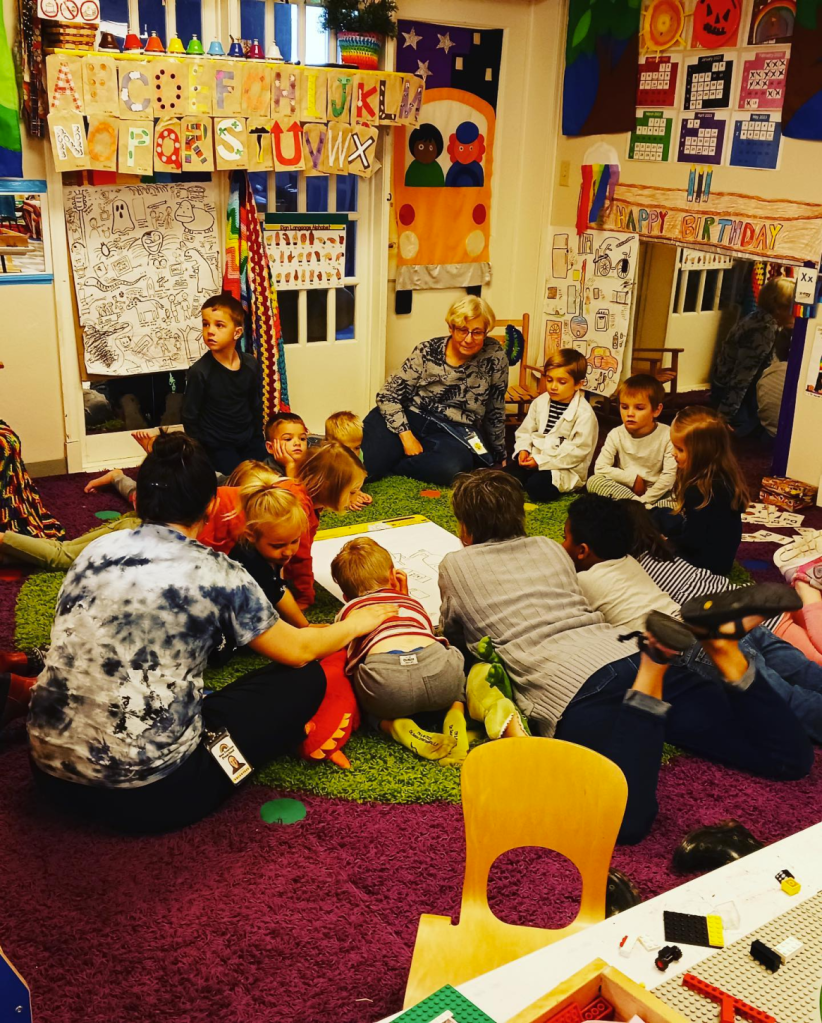
Incorporating a deep respect and appreciation of the young child we trust the child’s ability to learn to problem solve and embrace their ability for self-discovery. Our discipline approach is heavily influenced by Conscious Discipline® and the Magda Gerber’s Educaring® Approach.
THE BASIS OF OUR APPROACH: Respect is the basis of our philosophy. We respect children and demonstrate our respect every time we interact with them. Respecting a child means treating even the youngest as a unique human being, not as an object.
AN AUTHENTIC CHILD: An authentic child is one who feels secure, autonomous, and competent. We work to help a child to feel secure, appreciated and that “somebody is deeply, truly interested in me.”
TRUST IN THE CHILD’S COMPETENCE: We have basic trust in the child to be an initiator and an explorer eager to learn what they are ready for. We provide the child with only enough help necessary to allow the child to enjoy mastery of their own actions.
SENSITIVE OBSERVATION: Our method, guided by respect for the child’s competence, is observation. We observe carefully to understand the child’s communications and their needs. The more we observe, the more we understand and appreciate the enormous amount and speed of learning that happens during the first few years of life.
CONSISTENCY: We establish clearly defined limits and communicate our expectations to develop discipline. When a child is outside of the limits, we meet them with immediate goals of safety for all children and an understanding of why/how.
CAREGIVING TIMES: During care activities (bathroom, snack time, shoes/jackets/etc.), we encourage all children to become active participants rather than passive recipients of the activities. We create opportunities for interaction, cooperation, intimacy and mutual enjoyment by being wholeheartedly with the child during the time we spend together anyway.
THE ENVIRONMENT: Our role is to create an environment in which the child can best do all the things that the child would do naturally. The more predictable an environment is, the easier it is for them to learn. We give the children plenty of time for uninterrupted play. Instead of trying to teach new skills, we offer opportunities for them to learn those skills through play.

PROHIBITED PUNISHMENT FOR ALL LICENSED DAY CARE HOMES, CENTERS AND PRESCHOOLS: According to K.A.R. 28-4-427 (d) (2), punishment which is humiliating, frightening or physically harmful to the child shall be prohibited. Prohibited methods of punishment include: corporal punishment such as spanking with the hand or any implement, slapping, swatting, pulling.
If you suspect a child is being abused or neglected in Kansas, please contact the
Kansas Protection Report Center (KPRC) at 1-800-922-5330.
Telephone lines at the Kansas Protection Report Center are staffed 24 hours a day/7 days a week. Every call is taken seriously and every effort will be made to protect your identity. In the event of an emergency contact your local law enforcement or call 911.
 newcreationpreschool.com